
 Dams & Hydro
 Geotech
 Advanced Numerical Analysis
Geotech
Waterkloof Marina Development
Monument Park, Pretoria, South Africa

Central Developments constructed a large residential development (including multi-level structures) on a site in Monument Park situated partially on a historic clay quarry backfilled in places with uncontrolled brick and other rubble. The brick fill is up to 20m thick in places and highly variable in composition. This naturally posed a risk to structures founded upon it and required investigation and settlement mitigation measures. ARQ was tasked with, amongst others, the geotechnical investigation of uncontrolled fills, characterisation of materials and assistance in derivation of appropriate measures to afford safe construction of structures on this material (as removal and replacement was not economically viable).
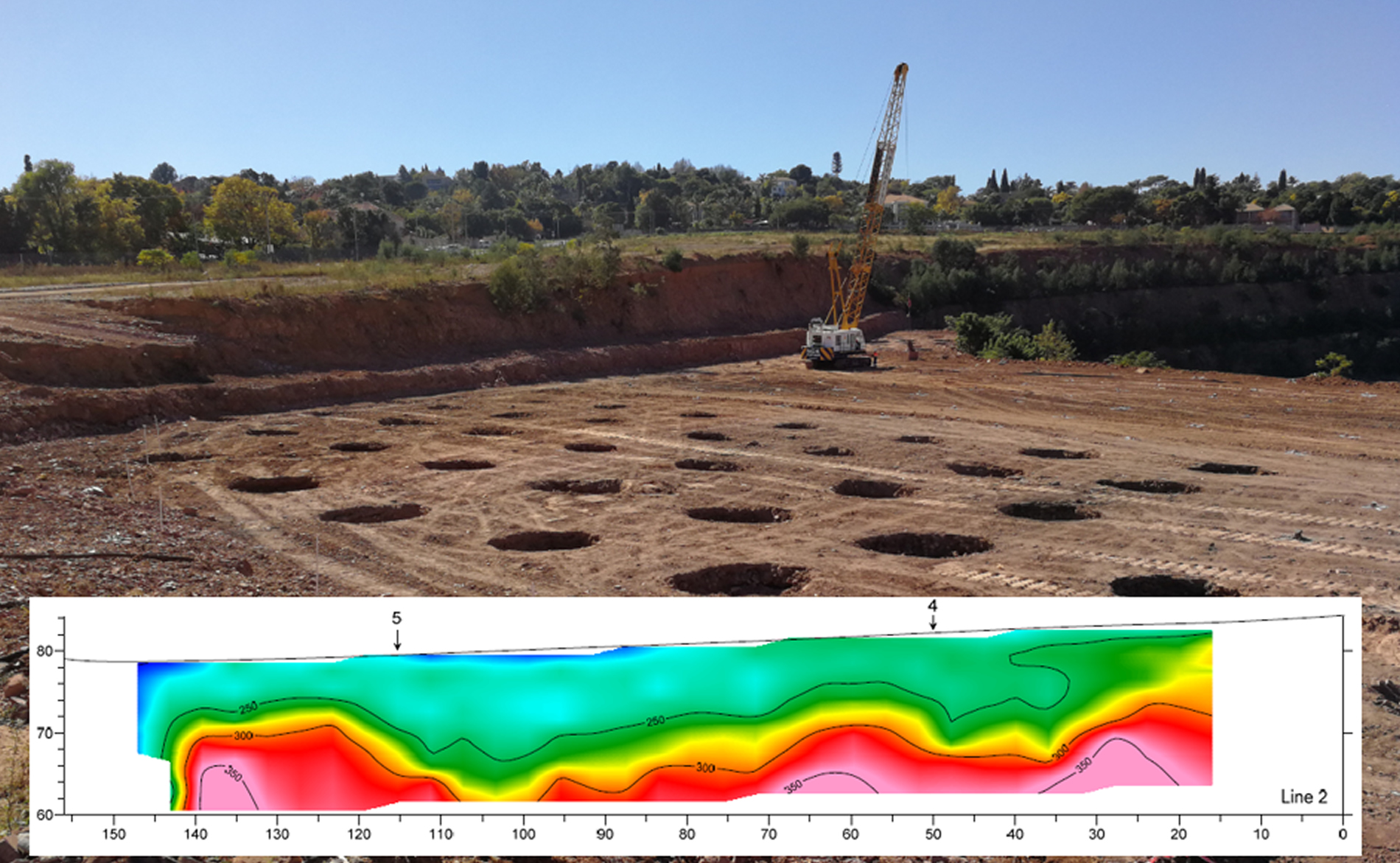
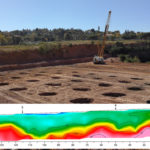
After extensive investigations, Dynamic compaction (DC) was conducted on the north western platform of the development to improve fill density and uniformity. See Figure 1 depicting the platform after primary DC.
The efficacy of the DC was then evaluated through the following mechanisms to quantify risk and to serve as input to appropriate foundation design for residential structures:
- Analysis of DC trial penetration data,
- Test pits (post DC),
- Geophysical testing (multi-channel analysis of surface waves – MASW), and
- Before and after ground surface survey to assess effect of densification.
Amongst the other investigative measures set out above, multi-channel analysis of surface waves (MASW) geophysical testing was conducted as the primary mechanism to assess the quality and efficacy of DC, and investigate the fill for anomalies or voiding. The MASW method entails measurement of velocity of shear waves which are emitted by a source, and propagate through the subsurface. MASW was selected over seismic refraction as it is more apt at providing accurate readings of possible soft zones overlain by denser/stiffer zones and is also not affected by the water table.
This testing had the added benefit of providing information to depths beyond the brick fill and establishing probable insitu shale rock level. Tests were conducted on five (5) traverses, almost 100m in length. Refer to Figure 2 below for a typical MASW profile and to Figure 3 for “before DC and after DC” test pit wall comparison showing densification effects.
MASW testing indicated no major low-density (soft) zones, though variable subsurface conditions were still present as expected.
The results of the investigation were used to quantify likely long-term settlements and differential settlements and were used as input into the design of appropriately stiffened reinforced concrete rafts for founding of structures.
The structures have subsequently been constructed and are preforming satisfactorily.
Project details
| DURATION | 2016 - Nov 2018 |