


 Dams & Hydro
 Geotech
 Advanced Numerical Analysis
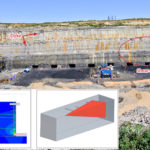
Blasting and excavation of a new highwall- Dorstfontein Coal Mine East
Download Publication (PDF)- By Gerrie van Jaarsveld, Principal Engineering Geologist, Rockland Geoscience;
- Werner Britz, Geotechnical Engineer, ARQ Geotech (Pty) Ltd;
- Thomas O’Brien, Geotechnical Engineer, HOD, ARQ Geotech (Pty) Ltd
Exxaro Resources is developing a new bord and pillar underground mine at its Dorstfontein Coal Mine East (DCME), 10 km north-east of the town of Kriel in Mpumalanga. The new underground mine will be accessed via seven portals driven from the base of the existing Pit 2 open cast operation.
In order to ensure the safe operation of the new underground mine, the existing Pit 2 highwall was redesigned to a slope geometry appropriate to the projected 20-year life of the new underground mine. Exxaro appointed specialist drilling and blasting contractor, Eire Contractors, to design the new highwall and execute the drilling and blasting thereof. Eire Contractors in turn retained the collaborative services of Rockland Geoscience and ARQ Geotech to design the highwall and monitor blasting and excavation works.
GEOLOGY
The new underground mine will exploit the no. 2 and 4 coal seams hosted within the coal-bearing sandstones and siltstones of the Permian Vryheid Formation, Ecca
Group, Karoo Supergroup. The rocks of the Vryheid Formation either rest conformably on diamictites and associated glaciogenic sediments of probable Dwyka age, or unconformably on basement rocks of the Lebowa Granite Suite, which in turn is underlain by volcanic rocks of the Loskop Formation.
GEOTECHNICAL INVESTIGATION
A geotechnical investigation was undertaken to generate geotechnical parameters as input to slope stability analyses. The geotechnical investigation consisted of a
desktop study of all available geotechnical information pertaining to the development; 3D terrestrial laser scanning of mining slopes to obtain the dip, dip direction, spacing and persistence of discontinuities; manual scan-line mapping of selected faces to ground truth the laser scanned data and inspect joint surface roughness profiles and infill; double tube rotary core drilling; down-hole acoustic and optical televiewer surveys of boreholes to determine the dip and dip direction of discontinuities in boreholes; and logging, sampling and laboratory testing of the borehole core.
Return